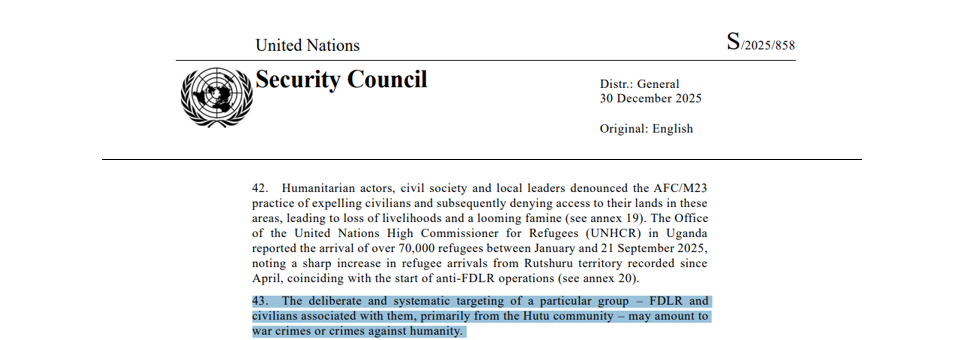
All For Rwanda takes note of the publication of the 2025–2026 midterm report of the United Nations Group of Experts on the Democratic Republic of the Congo, a reference document on the security and humanitarian dynamics prevailing in eastern DRC.
All For Rwanda notes that this report clearly and substantiatedly confirms elements that our movement has consistently brought to the attention of national and international stakeholders, both publicly and through diplomatic engagements: Hutu civilian populations — including Rwandan refugees and Congolese communities — are among the primary victims of the conflict, exposed to repeated violence, forced displacement, destruction of livelihoods, and chronic insecurity.
The report highlights a central finding: the insufficient distinction between security objectives and civilian populations has contributed to placing these communities in a situation of extreme vulnerability, despite their civilian status, their long-standing presence on Congolese territory, and their lack of involvement in current armed dynamics.
The Group of Experts further underscores that the deliberate and systematic targeting of civilian populations associated, in real or perceived terms, with security issues, particularly when it disproportionately affects an identifiable civilian group, may constitute, under international humanitarian law, a war crime or even a crime against humanity. These findings warrant particular attention and call for a response grounded in the rule of law and the protection of civilians.
All For Rwanda recalls that it has repeatedly warned of the foreseeable consequences of an excessively security-driven approach, insufficiently articulated around civilian protection and international refugee law. The Group of Experts’ report now objectively substantiates these warnings and calls for a pragmatic, responsible, and legally grounded reassessment of existing frameworks of action.
In this context, All For Rwanda emphasizes that the Washington Agreement represents a significant diplomatic achievement, made possible by the decisive engagement of the United States, which proved essential in containing military escalation and reopening political space. This engagement remains indispensable, both for the implementation of the agreement and for its targeted adjustment, in light of the realities established by the United Nations.
It is now necessary that the momentum generated in Washington more explicitly integrate the situation of affected civilian populations, particularly Rwandan Hutu civilian refugees and Congolese Hutu civilian communities, as a central humanitarian and political issue.
All For Rwanda is convinced that neither lasting peace nor the stabilization required to fully unlock the region’s economic and commercial potential can be achieved without a specific, distinct, and structured approach to the issue of Rwandan civilian refugees, based on their protection as a non-combatant population and on addressing the political factors that continue to obstruct their return.
Operational Recommendations
In a constructive spirit and in full compatibility with the framework of the Washington Agreement, All For Rwanda puts forward the following recommendations:
- Formally integrate the situation of Rwandan Hutu civilian refugees into the monitoring mechanisms of the Washington Agreement, as a complementary humanitarian and political pillar, in order to ensure the relevance, effectiveness, and sustainability of the existing framework, recognizing that an approach based exclusively on the military neutralization of “FDLR and associated groups” is, on its own, insufficient to produce durable stabilization.
- Ensure the effective and immediate implementation of the existing United Nations Security Council sanctions regime relating to the Democratic Republic of the Congo, on the basis of the facts established and documented by the United Nations Group of Experts, and in parallel, engage the competent international bodies to conduct specific, independent, and impartial investigations aimed at completing the establishment of individual responsibility and strengthening the prevention of future violations.
- Call upon the United Nations High Commissioner for Refugees (UNHCR) to cease any practice or support that may amount to forced or coerced returns of Rwandan refugees from the Democratic Republic of the Congo to Rwanda, and to strictly reaffirm respect for the principle of non-refoulement. Any return initiative must be based exclusively on voluntariness, effective safety, and dignity, in accordance with international refugee law.
- Establish a structured and consultative mechanism with representatives of Rwandan refugees, mandated to work on:
- the political, legal, and security-related concerns that obstruct their return;
- the conditions for a large-scale, voluntary, safe, and dignified return, based on credible guarantees.
- Deploy specific and targeted humanitarian assistance for affected Rwandan Hutu civilian refugees and Congolese Hutu civilian communities, adapted to the protracted nature of their situation and coordinated with the relevant agencies.
All For Rwanda reaffirms its readiness to contribute, in a responsible and solution-oriented manner, to ongoing efforts. The recognition and protection of Rwandan Hutu civilian refugees and Congolese Hutu civilian communities constitute an indispensable condition for the credibility and durability of any peace process.
ALL FOR RWANDA